
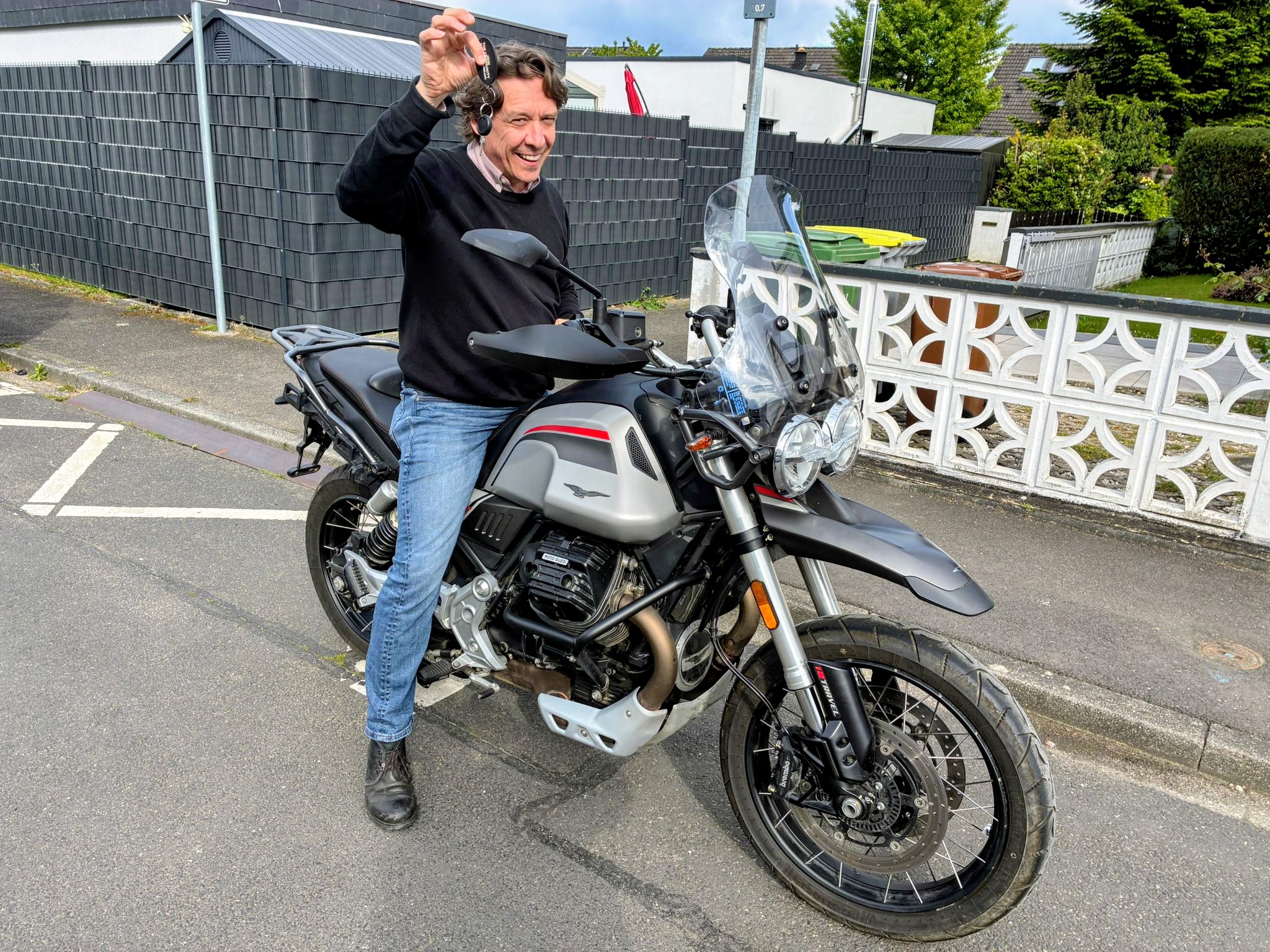
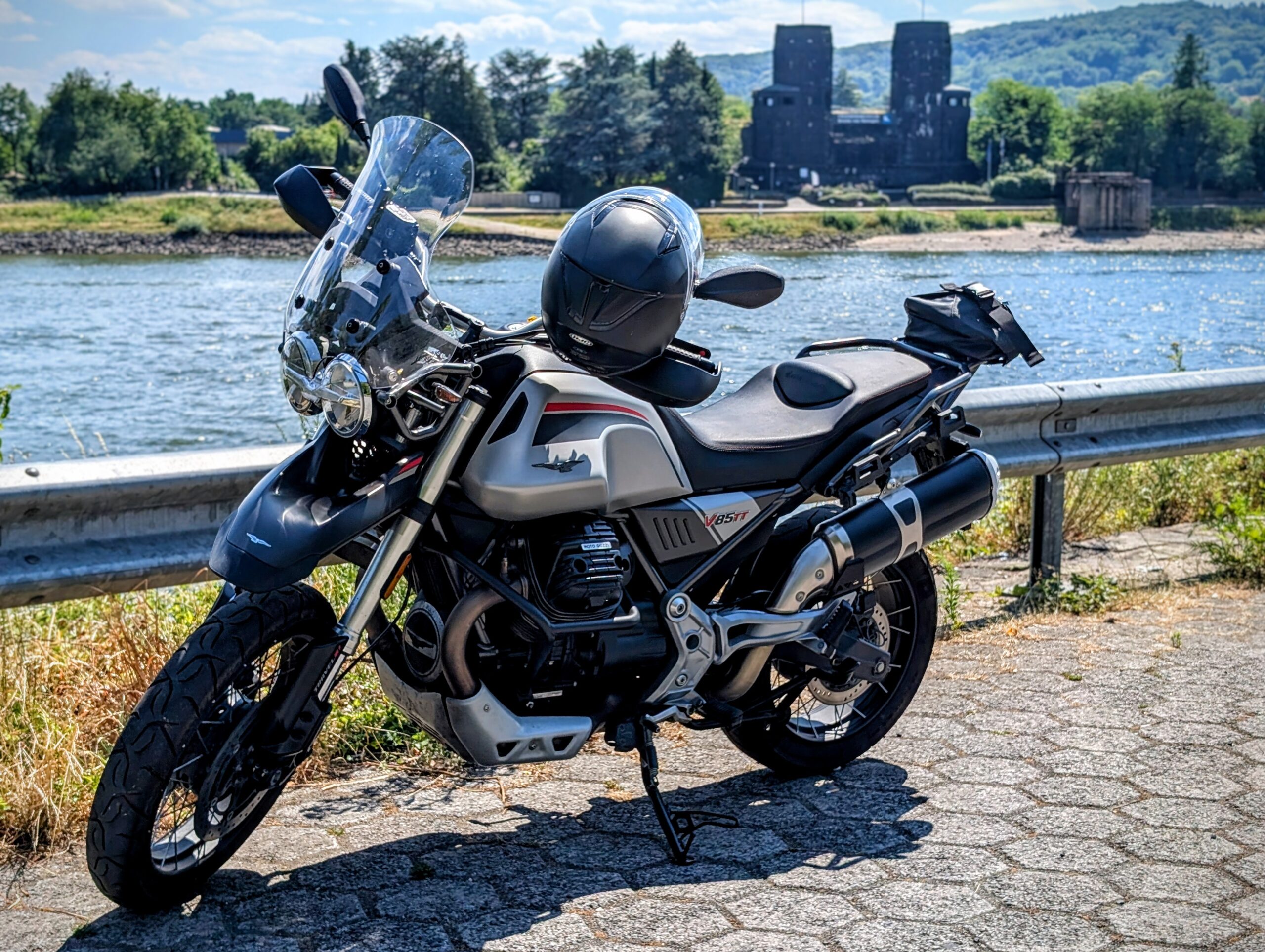
It was never on my list but I am now the owner of a Moto Guzzi V85TT Travel, 2022. Unexpected? Yes. Exciting? Yes. Will it tour? That’s the plan, and this is how it’s going. Read my ongoing, updating, extended review.
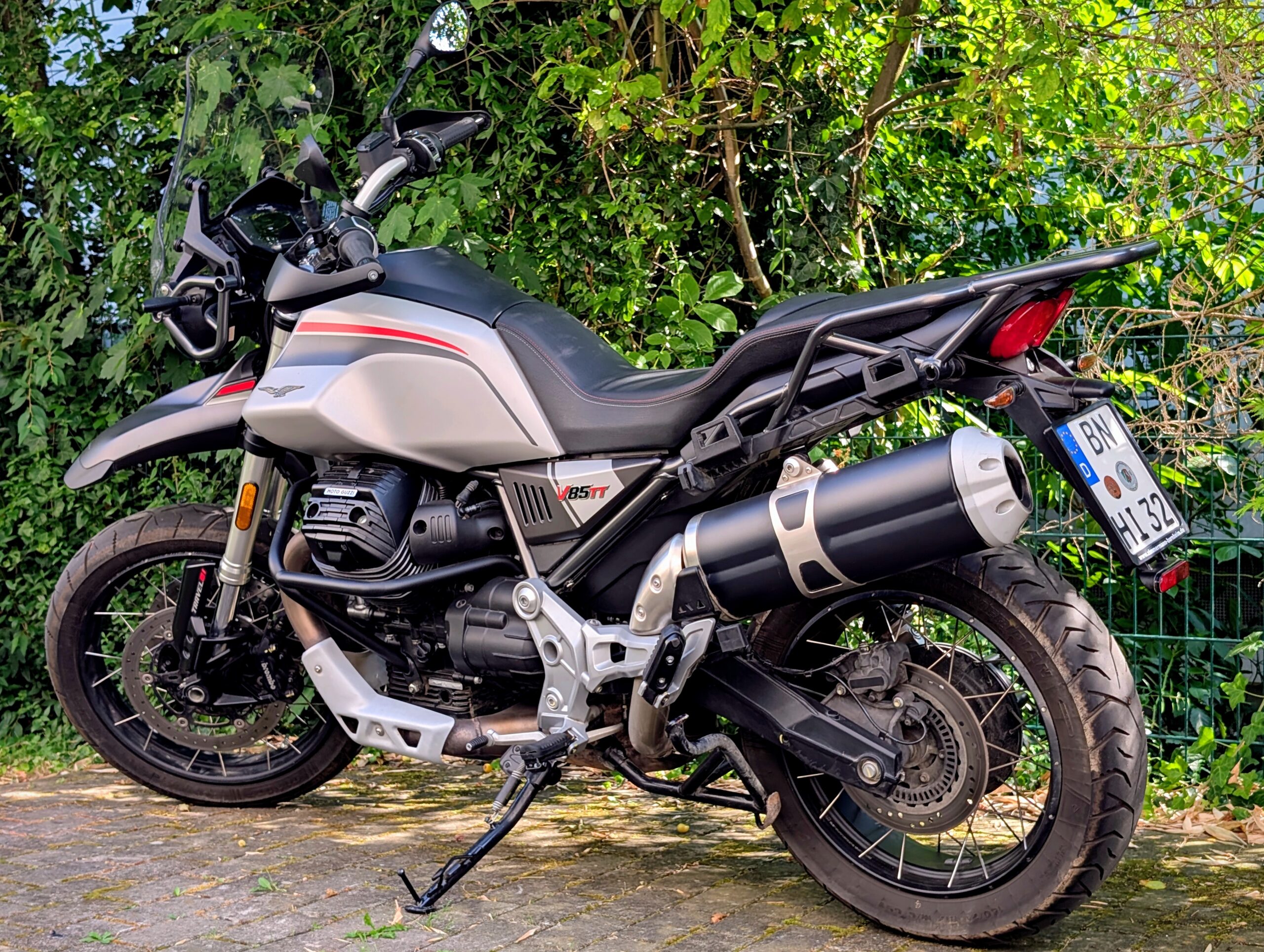
I acquired the V85 TT Travel, 2022 model, in May 2026 for €8100 with 10.5k km on the clock. This review is updating regularly.
August 2026. Kilometers traveled so far: 2500.
17 October 2026. Kilometers traveled so far: 6000.
A summary review of the V855 TT Travel (2022)
A characterful and comfortable, touring adventure bike, the V85 TT Travel will support you in efficient and relaxed long-distance discovery. It’s a tractor at the traffic lights, a smooth runner in the hills and has its limits on the motorway. It doesn’t behave well when it’s warming-up!
It’s designed for getting to far-away places in comfort and exploring those places when you arrive. You’ll have fun, you’ll feel proud, you’ll enjoy the torque and you’ll get annoyed at luggage falling out of the panniers every time you try to get something out. 130 km/h cruising is possible. 120 km/h is better. Winding country roads are even better.
My background
Born in 1968 I’m 174cm tall (5′ 8″) and fairly slim. I’ve toured around France, Great Britain, New Zealand and a lot of Germany, Belgium and Luxembourg.
My previous bike was (and still is) a Honda VFR 800 Gen 6 sports tourer but I’ve tried plenty of bikes in my life. This is, however, my first adventure tourer.
I live in Bonn, Germany and I regularly ride the Eifel and Westerwald regions. I also love camping.
Say hi! and ask questions on Instagram.
Why buy a V85 TT Travel?
In June 2027 I will be attempting a 10000 km tour of south east Europe. While I love my Honda VFR800 for reliable and fast long distance tours, (five countries in a day?) it’s a struggle at low speeds and it’s tough on my back and shoulders. The V85TT is unlikely to make any quickly-researched shortlists but if you look carefully, you’ll find it and it might just meet your requirements. In terms of that tour, it’s met every requirement so far.
Recent tours include a 2 day tour of the Hunsrück region in Germany and a 550 km (341 miles) single day, five country tour to give the seat a full-on test. I have a camping weekend planned for September 2026.
Full Review of the V85TT Travel.
First ride: easy. This is a really welcoming bike to ride with a smooth, forgiving clutch and plenty of low-down torque.
Karchang! Chug! chug! Brap! Brap! The official sound of a V85 TT! It sounds great under low-rev load. Brap brap!
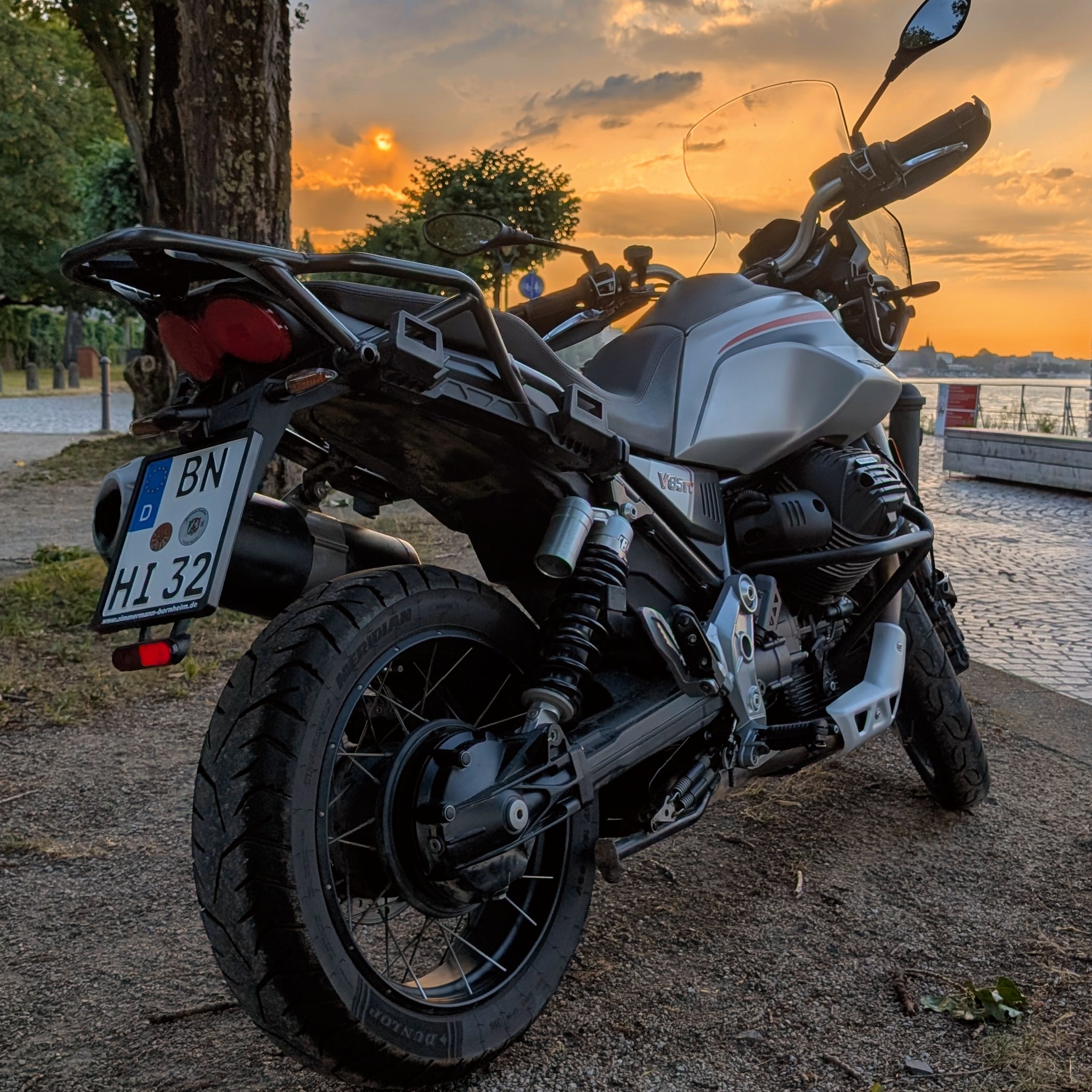
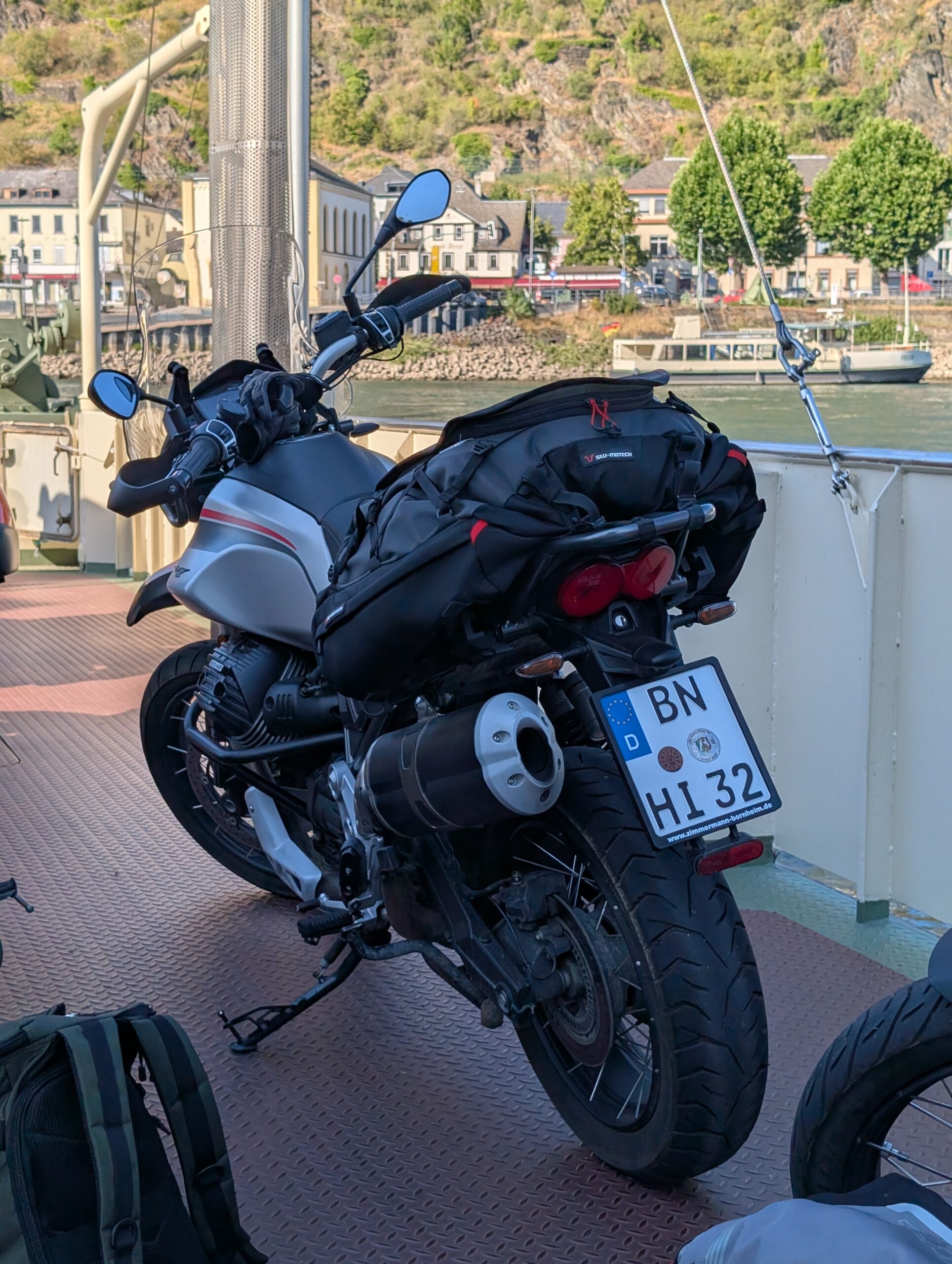
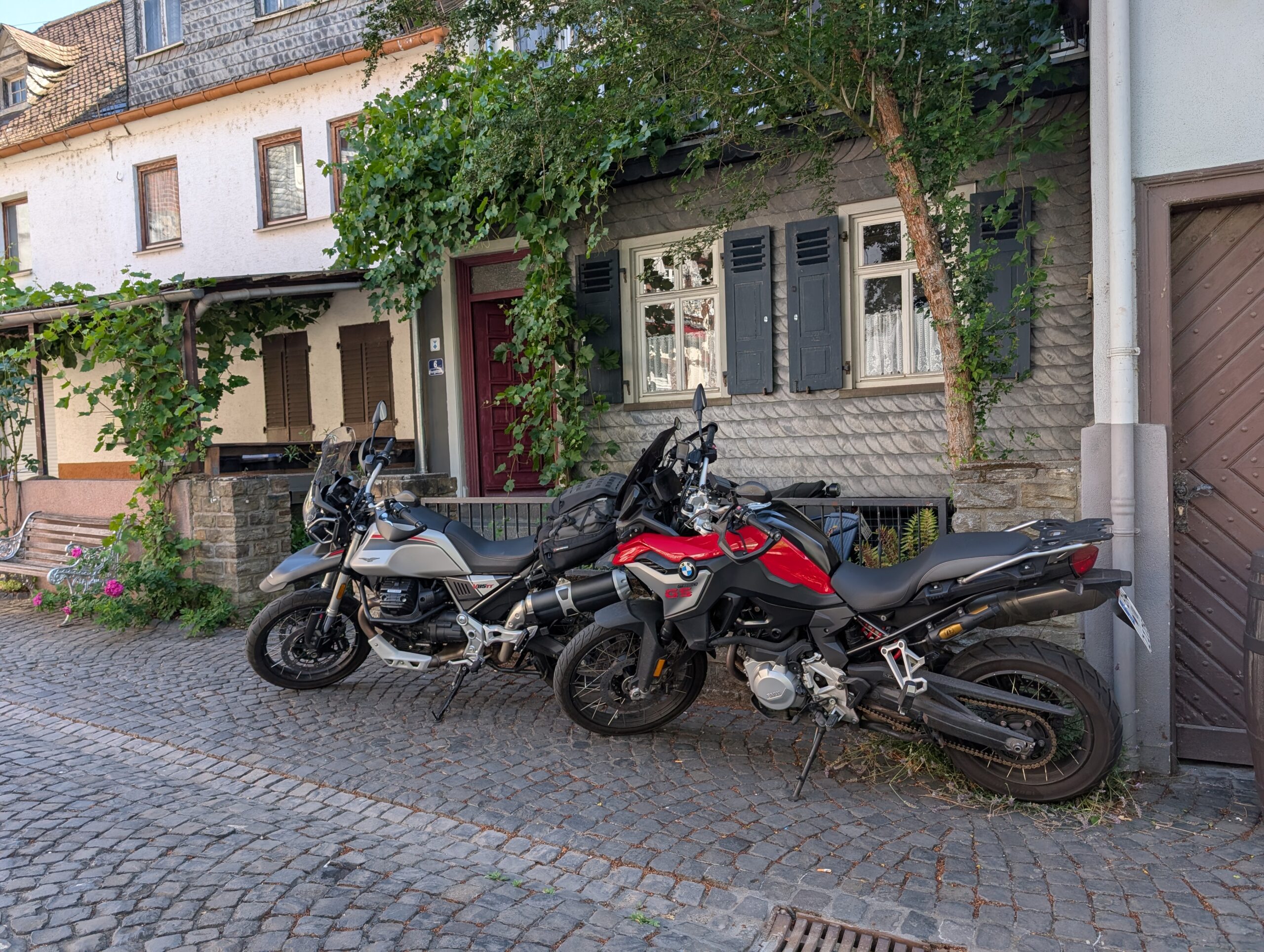
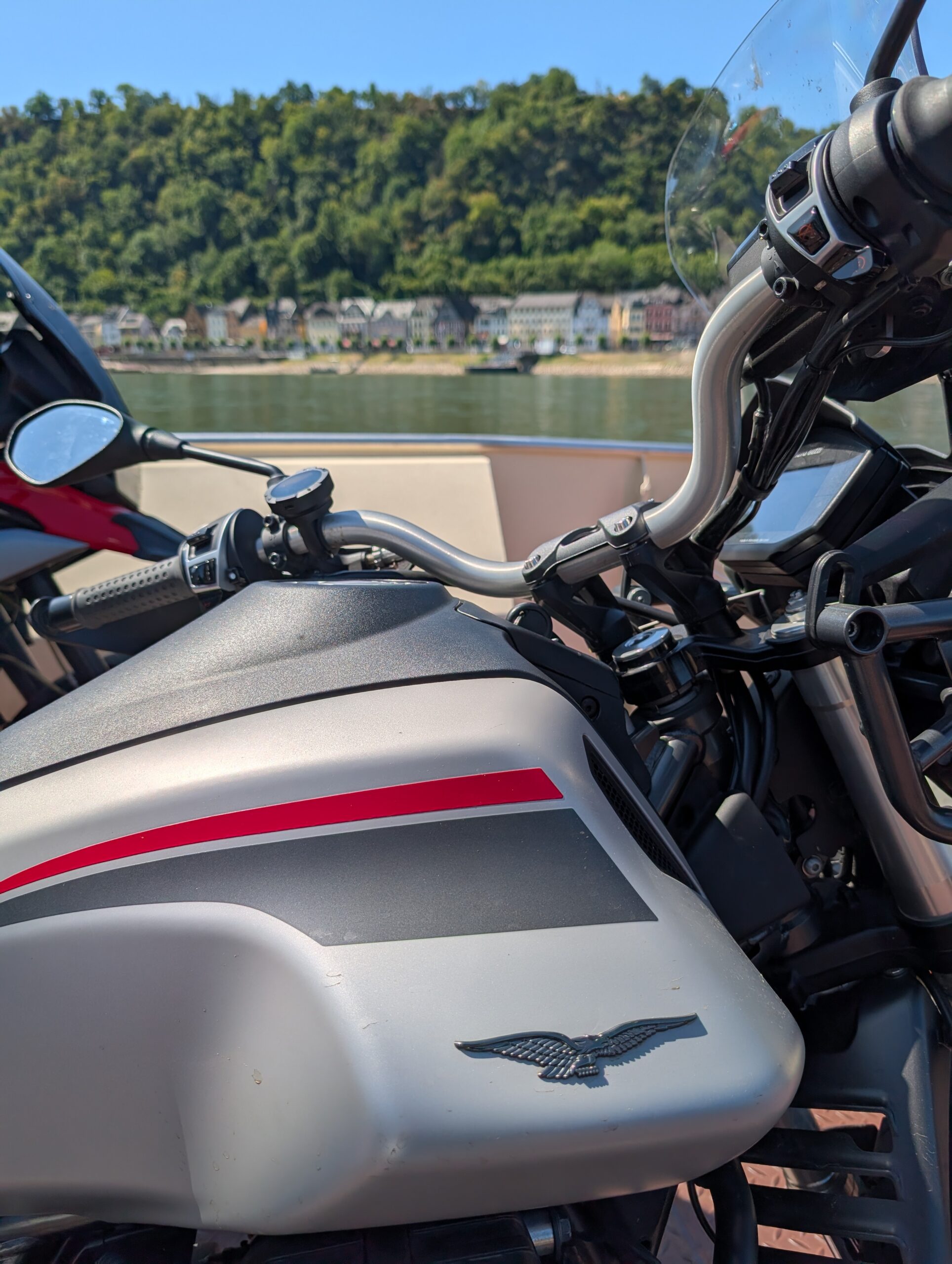
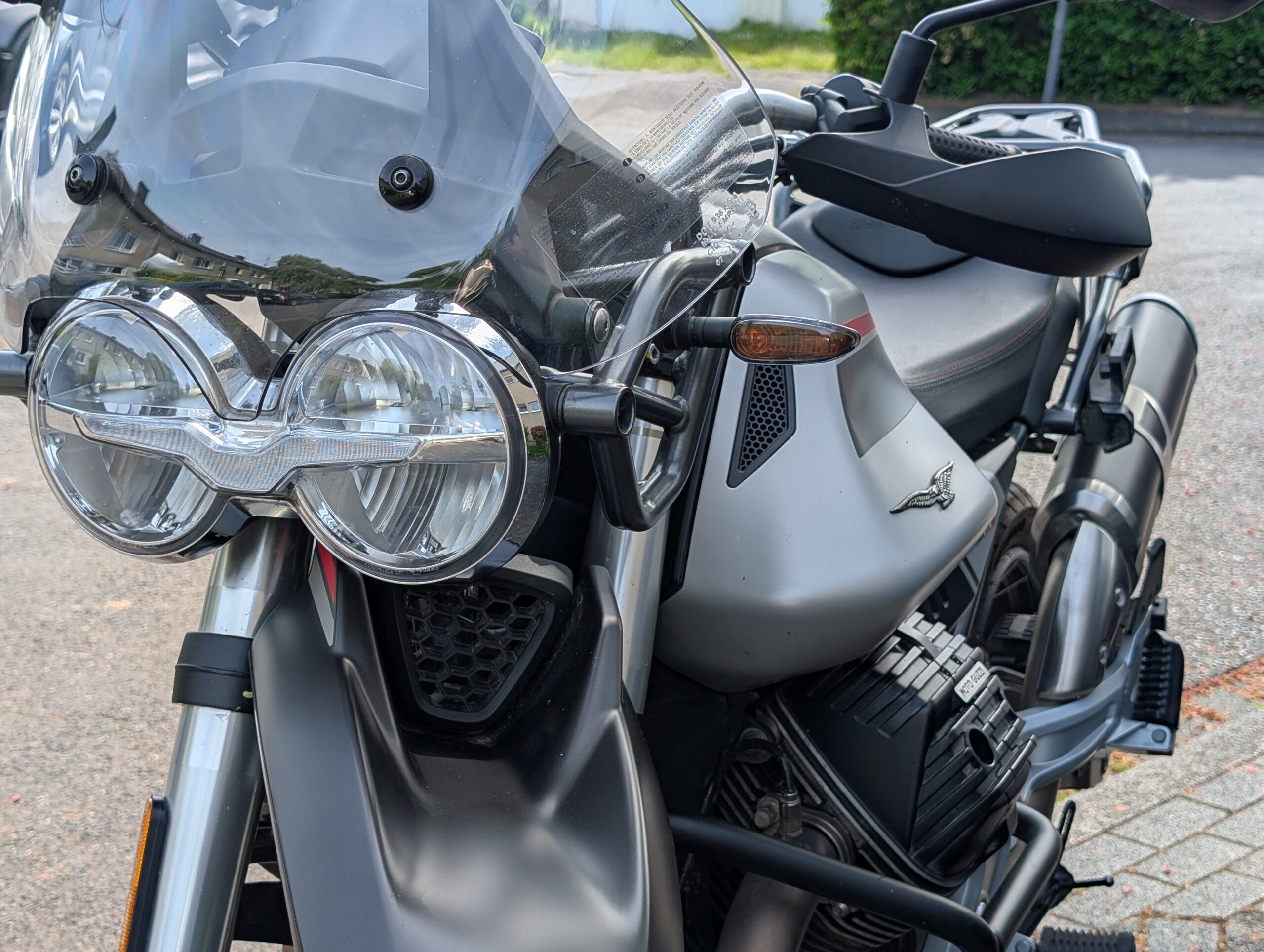
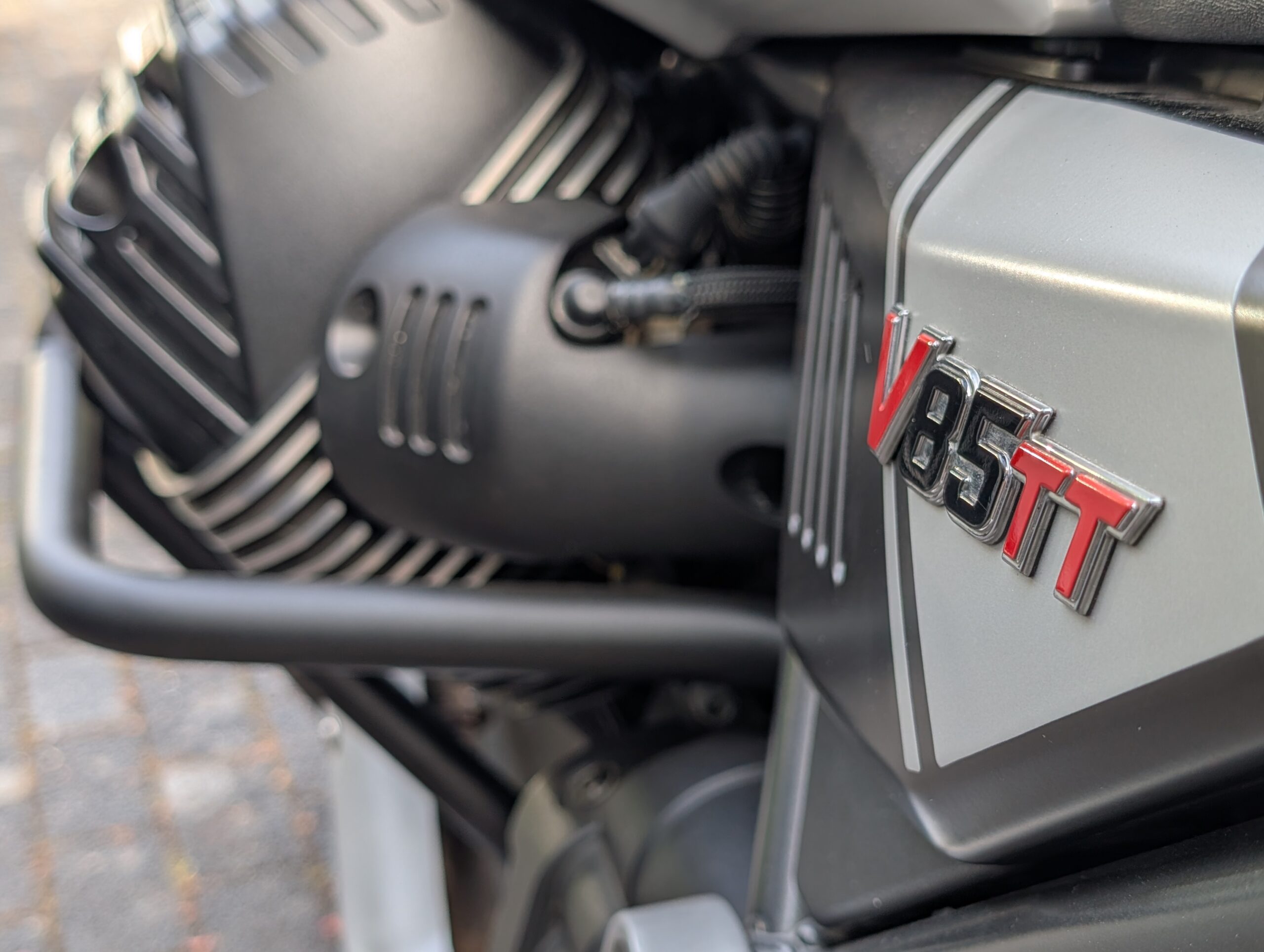
Design and feel. It looks like a classic bike, and yet different. There isn’t a bad angle in my opinion. Take a look at some of of the photo’s I’ve taken below and see what you think. It’s unique, right?
Power. 75 PS and a shaft drive.
Later versions, from 2024, have the variable valve timing and are re-mapped to 80 PS but this version is certainly enough for one-person, multi-week touring. For winding country roads, especially with that torque, it’s spot on.
You’ll reach limits if you head out with a bunch of Honda RC30s as I did recently and a 130-150km/h cruising range feels strained. 160km is achievable but at that speed you’re riding a brick, and it shows in the fuel consumption. For anything over 160 km/h, forget it. Note: I live in Germany.
Sport mode in town can catch you out on the V85 TT as the digital throttle is not hugely refined at low speeds. It can surprise you, especially when warming up.
Powering out of switchbacks on the V85TT is just so much fun. The tourque! #motosky #v85tt
— Chippy (@meetmobility.com) July 18, 2026 at 10:31 AM
[image or embed]
Seat and height. The height is turning out better than I thought but 174 cm tall, (31 inches inseam) I’m not able to flat-foot on the 830 cm seat height and it means there’s a few cm missing for those fall-away road moments. I don’t feel as confident pulling up at traffic lights. I’ve had to steady the bike a few times.
As for the seat comfort, it seems comfortable but wide. There are a few positions you can take up and, so far, I have been very happy. In one 530 km single -day tour it was my arms that were feeling tired, not my back or my bum and compared to my (comfortable) VFR800 it’s a lot better all round. Cruise control is my new must-have.
Weight. It’s a heavy bike but not much more than my VFR 800 so I’m not too worried. It’s easier to push around the garage, probably because of the longer bars.
The weight might be the reason it feels so stable and on point when cruising. It’s a bike that you can sit comfortably on at 120 km/h for a very long time.
Switchgear. It’s different, yes, but you’ll probably know about that before you buy it. I have absolutely no issue with the layout and quirky switches. Yes, I’ve hit the high beam by accident a few times and yes the push-to-toggle cut switch catches you out occasionally.
Oh, you’ll need to try the steering lock about 1000 times before you understand exactly how and where you push down, but I’ve got it now.
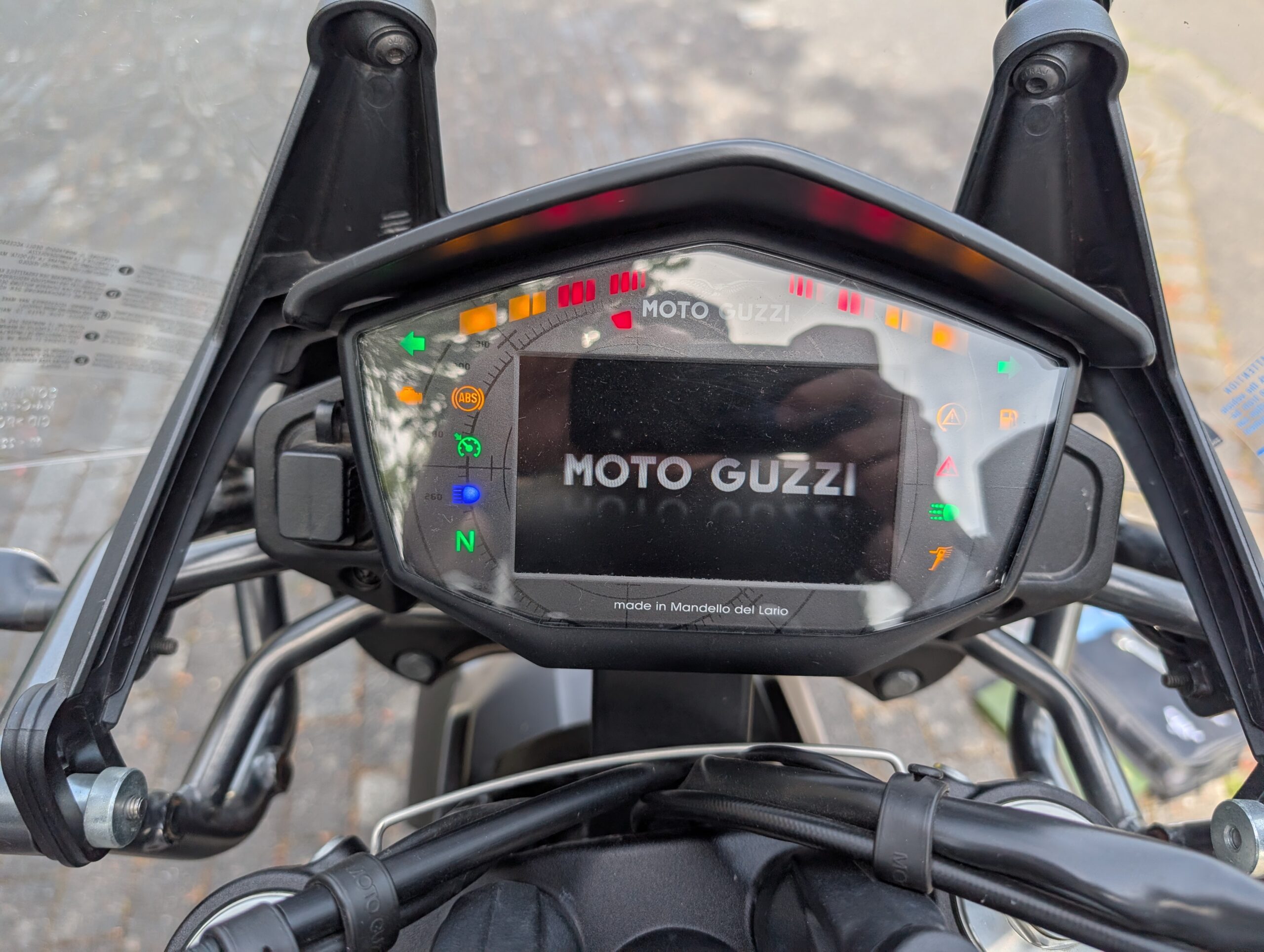
Instrument cluster…not the best design. A combo of flashing lights and a small LCD panel.
This is certainly not what my idea of Italian style is and it’s not even functionality focused. I suspect there are safety rules being considered here.
An example: The lights-on indicator is on when only the ‘eagle’ running light is lit and not when the low-beam is on.
Screen characters could be bigger, for old eyes.
Luggage. The 61 liter hard plastic luggage is surprisingly sturdy and is easy to remove. It’s nicely branded and uses a single key locking system. However, they open sideways and one of them has an awkward shape that fits around the exhaust. You will need to use liners or packing cubes to get the best out of them but you will be annoyed trying to use them mid-tour.
The best way to use the luggage is to consider them as suitcases that you unmount and use at your destination and not while you’re riding. Keep your regularly used items in a top box, cargo bag or tank bag.
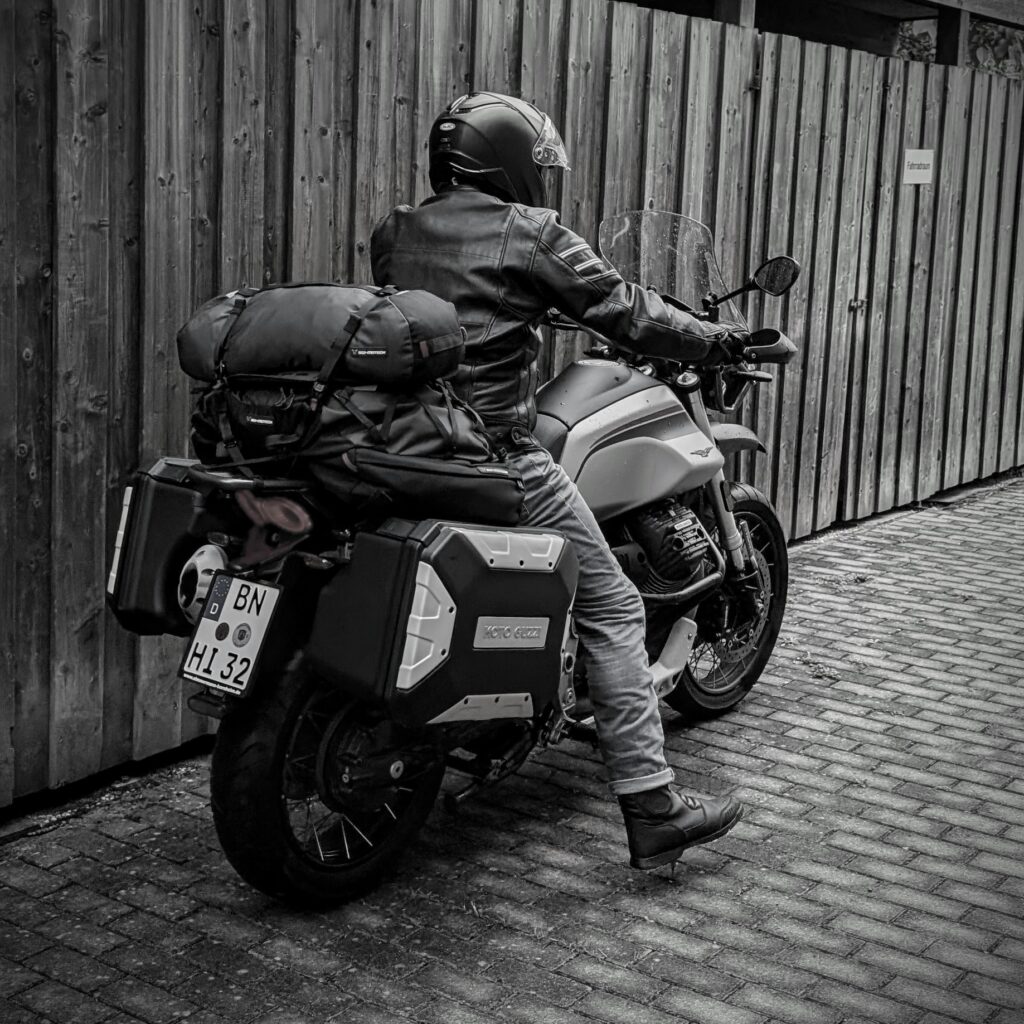
The luggage mounting frame includes a small rear rack.
I have confirmed that the 50l SW Motech Pro Cargo Bag works. After a 2 day tour I was really happy with the style and function.
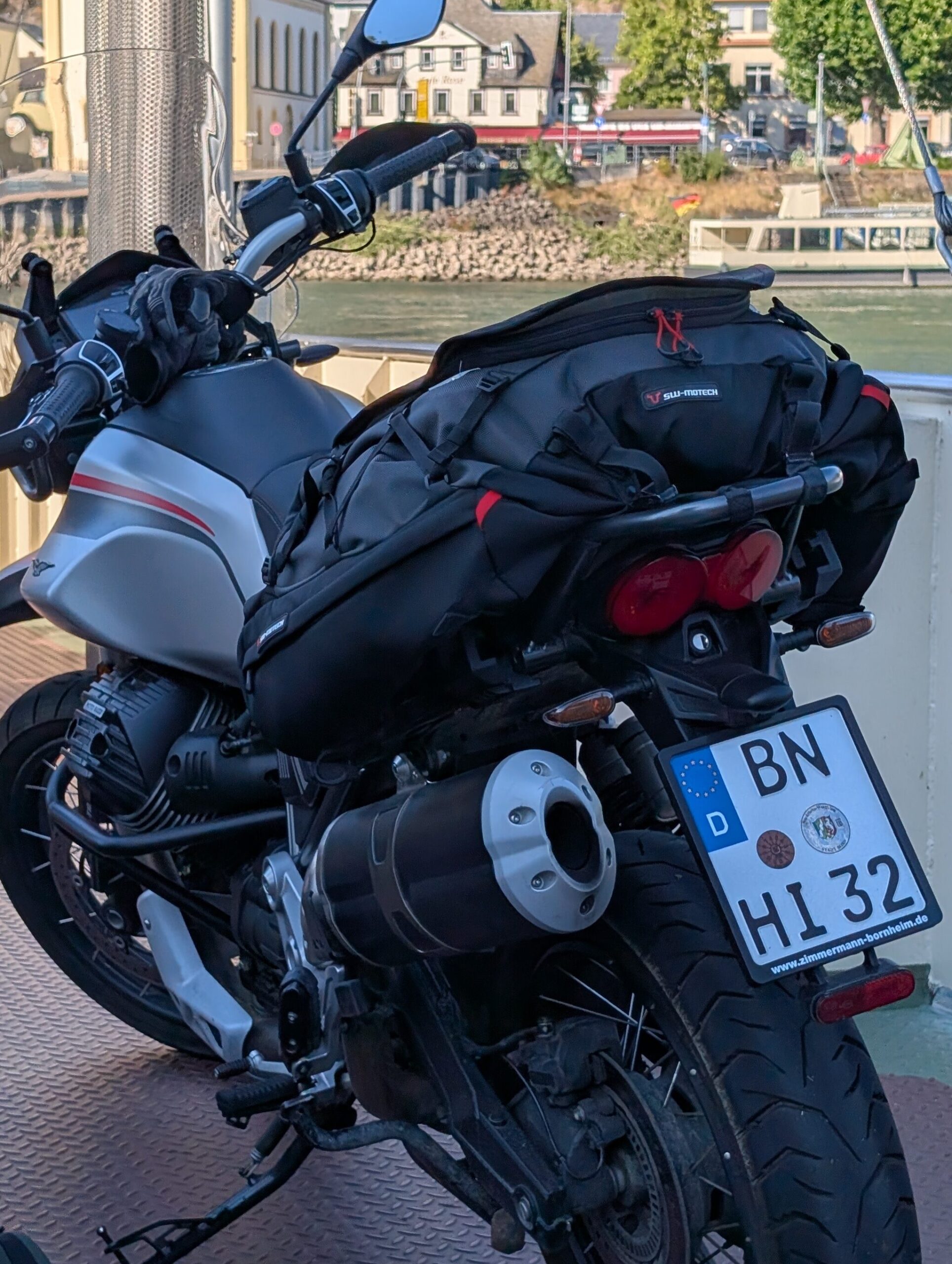
The hard luggage will fit underneath that cargo bag so the fact that the luggage opens outwards is a bonus in this setup.
I’ve written a separate report on the V85TT luggage. I’m having some success with a cargo bag.
Screen. The Travel variant has the largest of the screen options. Up to 80 km/h it’s offers loads of protection. Above that i’m finding a resonance with my helmet that needs breaking up. The screen has a small amount of angle adjustment so I have tipped the screen towards me now and it seems to have reduced the turbulence.
The hex key for adjusting the screen is under the seat on the top of the battery cover.
Gears, clunk! They take time and neutral can be a problem on the downshift, but it’s a solid gearbox, with a solid clunk.
Others have mentioned that it can become a personal challenge to get a smooth gear change and I can understand that!
Speed and acceleration. My instrument panel shows that I’ve hit 165 km/h but this isn’t a high-speed touring bike. It will glide along at 120 km/h all day and it will pull extremely well up until 100 km/h. Note that the indicated speed is about 10% too fast with my sports-focused tyres.
This bike is about tourque and i’ll be honest – I think it’s teasing me to be faster than I should be. Maybe it’s the exhaust note.
Brakes / ABS. The brakes are good to very good but I need more testing. Info coming soon.
Traction control. Info coming soon as I explore the modes and get close to some limits.
Suspension. After a few thousand kilometres I’m still without opinion on it. It’s comfortable and it takes me to the edge of my tyres but I feel there’s perhaps something missing on the rear setup that I need to adjust. I’ll update.
Sound: I’m loving it but there’s no doubt that it rattles all over the place. Whether it’s the clutch and the shaft driving picking up, the gearbox clunk or the raw engine sound, you can hear everything. There’s tunnel-potential with the exhaust on the V85 TT though, if you know what I mean!
Pinking: The 2022 model does pink when hot, under load and at about 3000 RPM. I don’t like that at all and it worries me a little. There are solutions to that, and there’s also the 2024 version with VVT!
The cold-engine problem: The V85TT likes to be nicely warmed up before it gives you stable fuelling. For the first 10 minutes, even on a warm, sunny day, it’s not settled and low-speed control isn’t easy. Annoying if your commute into the city is only 15 minutes long.
The neutral gear problem: Finding neutral from 1st isn’t easy. Finding it from 2nd is an art. I’ve even seen the display registering the wrong gear while searching so watch out! You’ll get used to it though, and you’ll have a better hit-rate when you aren’t moving and come up from first gear. Not an issue.
Efficiency: The V85TT is extremely efficient up to about 80 km/h, especially without luggage. Ride faster than that though and it shows its shape. At 120 km/h with luggage you’re not exactly cutting through the air and you’ll see that in the fuel consumption figures. On country tours I’m seeing 4.1 liters per 100 km (which again is probably 10% better than the real figure.) At motorway speeds with the luggage, 6 l / 100km.
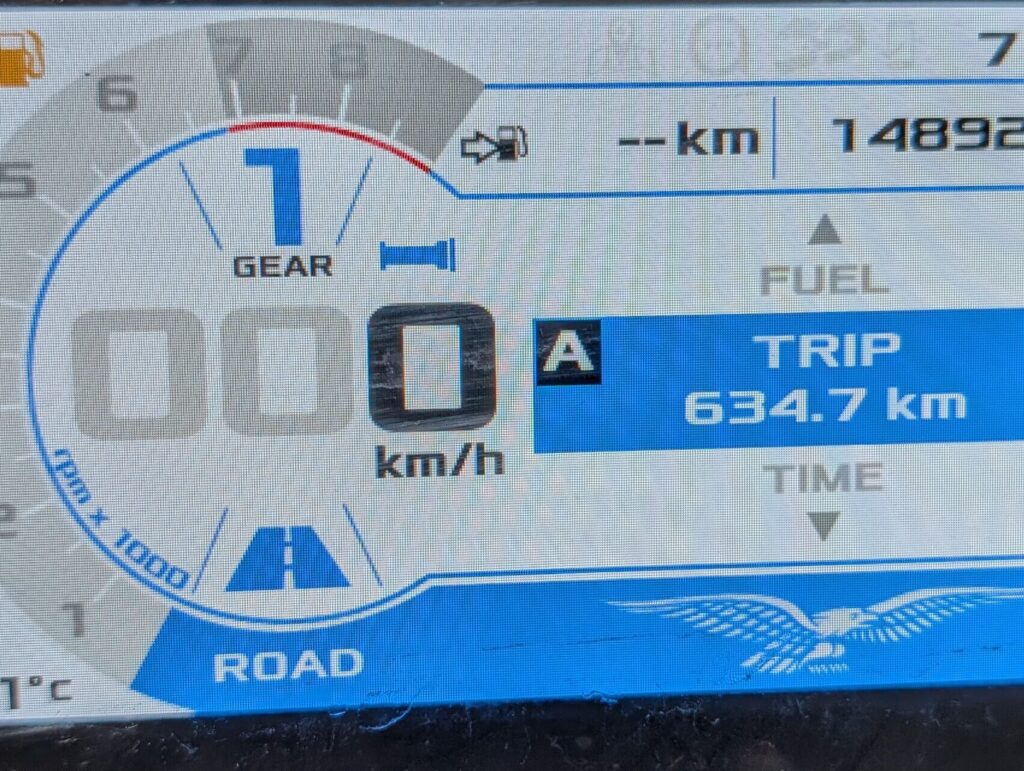
The fuel light will come on at 150 km if you’re pootling around. 100km if there’s a bit of gung-ho in the calculation. It’s annoying because you could end up running on the fuel light for many, many days of town commuting, to the point where you’re going to learn to ignore that light. Even more annoying is that when the fuel range is at zero you’ve got approximately five litres of fuel left in the system. That’s 100 km if you’re taking it easy.
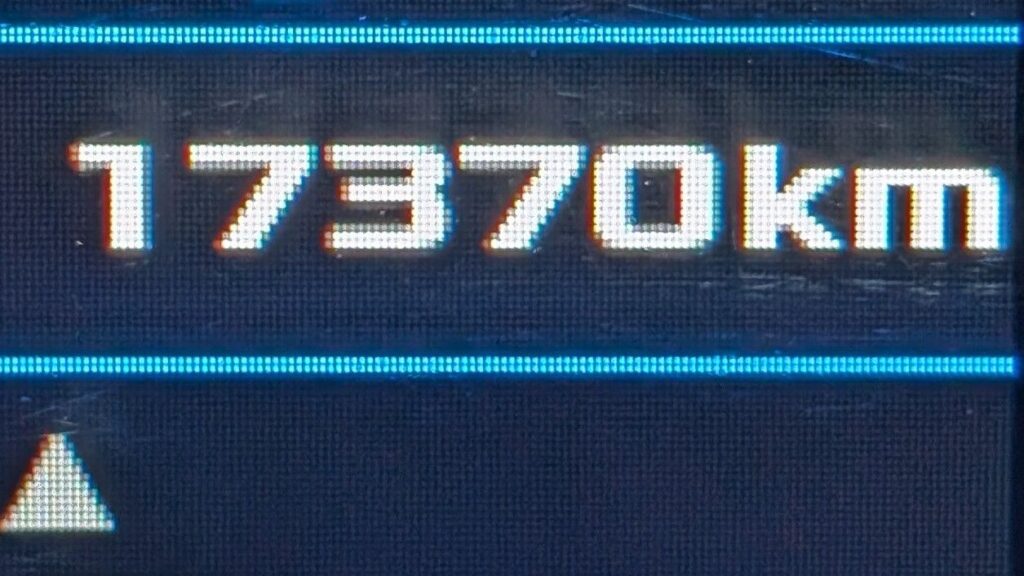
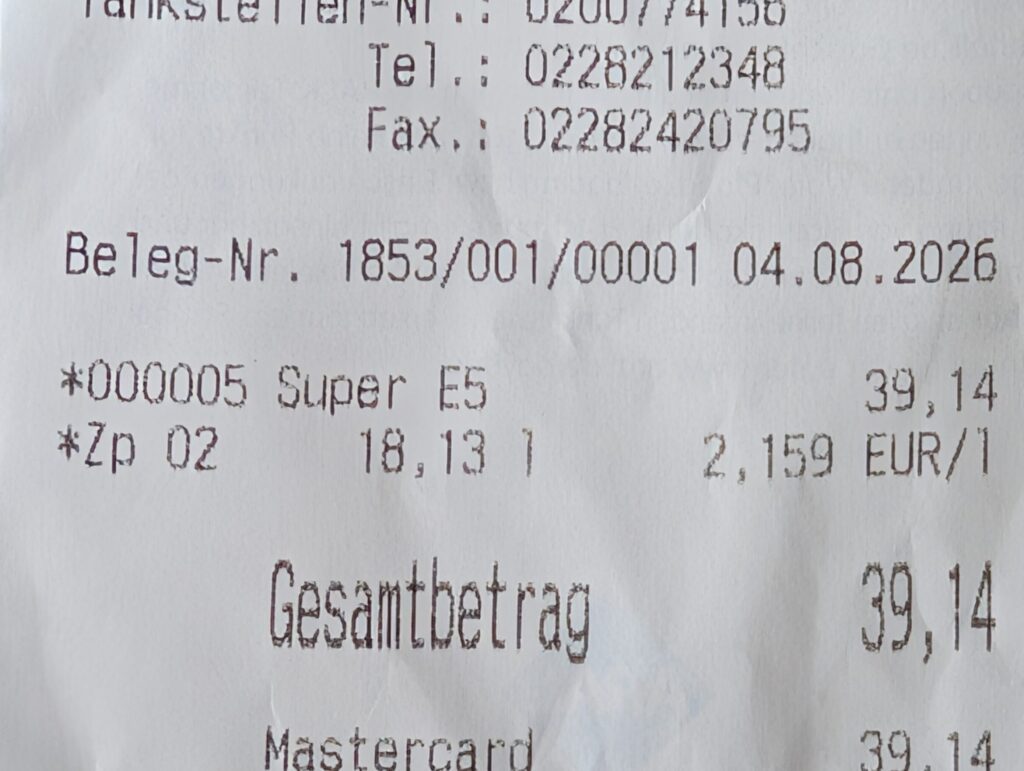
Here are two images taken within minutes of each other. The first shows zero km remaining. Ignore the trip reading on that. The second shows you how much fuel I could squeeze in while on the center stand. 18.13 liters.
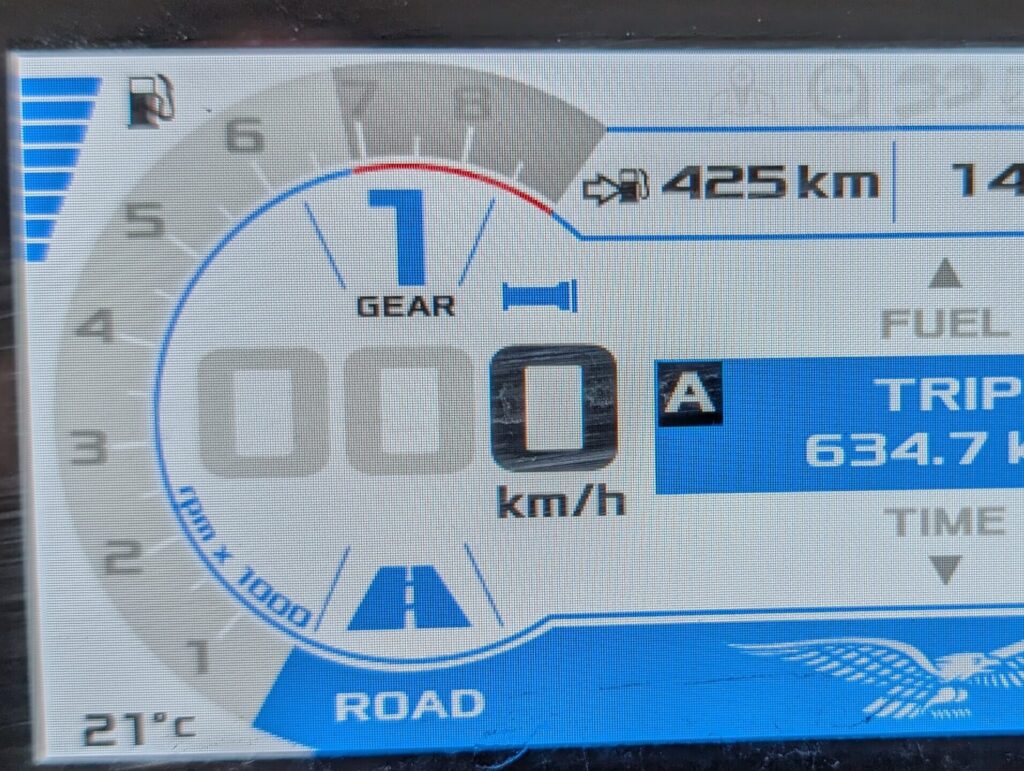
The full tank range shown on the right is 425km.
I’ve got a little plan in my head – hypermiling the V85 TT Travel. 600 km on one tanke should be possible.
Do you have the V85 TT?
How’s your mileage?
Handling. I’ve been doing a lot of technical slow-speed excersises and it feels incredibly manouverable at low speed. The turning circle is extremely tight. Around mountain twisty and switchback territory I find it stable, confidence-inspiring and fun. I’ve reached the edge of the rear tyre but need to changer them before I do any more extreme testing. More information coming soon.
Heat. There’s less heat than on my gen 6 VFR800 but that’s not saying much! It’s warm, for sure, and uncomfortable around the ankles if you haven’t got long boots on.
I keep looking for the water temperature reading on the dash but, of course, there isn’t one!
Cruise control. Easy, simple, works.
Navigation / Bluetooth: The V85 TT Travel includes the MIA bluetooth feature that couples a smartphone with the Moto Guzzi app and displays turn by turn navigation on the built-in screen.
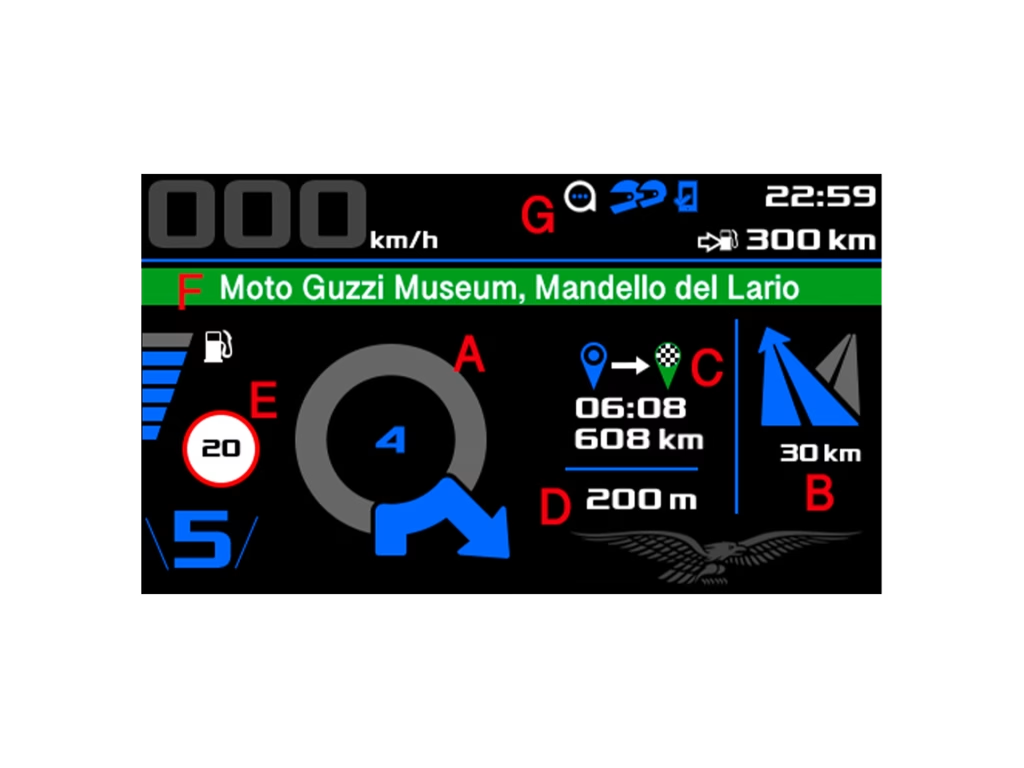
I’ve fitted a Beeline Moto 2 (full review here) and an SC Connect holder and i’m testing three solutions and will write a full report when the testing is complete.
Neither the Moto II nor the built-in navigation solutions are as good as Calimoto for planning, but there’s always something positive to be said for a built in solution, although in terms of route planning, the MIA navigation solution is the most basic.
3 years for €25 seems like a very fair price, as long as the app remains active for three years.
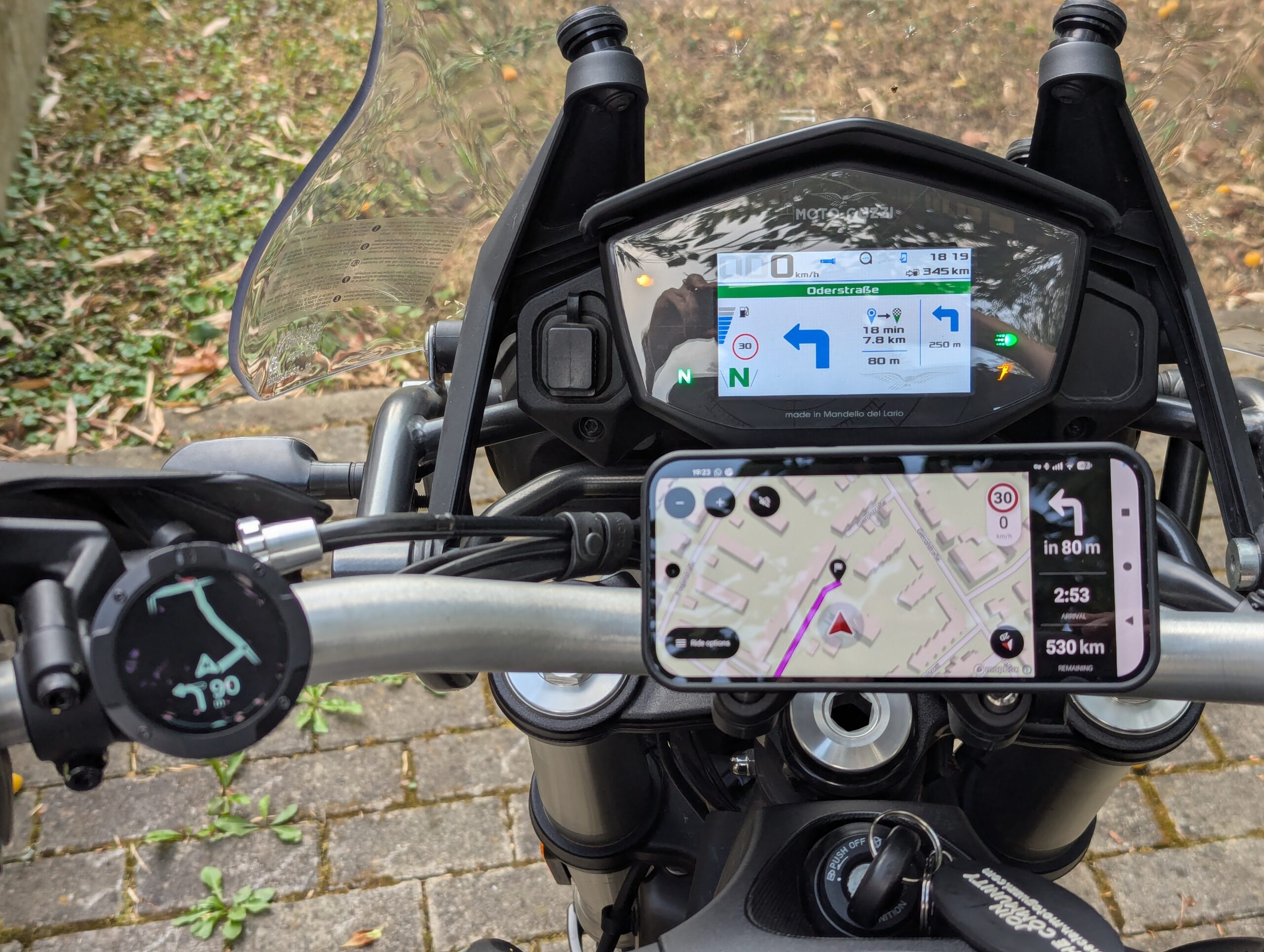
The built-in navigation app includes GPX importing but there’s no editing available on imported routes. I’ve already used multi-waypoint planning and Here navigation, the third party solution that drives the navigation solution, appears to offer alternative routes that you can click on to activate but there is no on-screen route dragging or ability to add waypoints via tapping on the map. For a touchscreen app, this is a bizarre omission and it feels like I’m back in 2010. Compared to Calimoto and Beeline it’s very poor.
And surely route planning is a key part of the fun of motorcycle navigation, dragging routes around based on elevation, highlights and favourites, time of day, weather and personal preferences.
It’s clear to me that this is just an app for getting somewhere safely, and it seems to do that well.
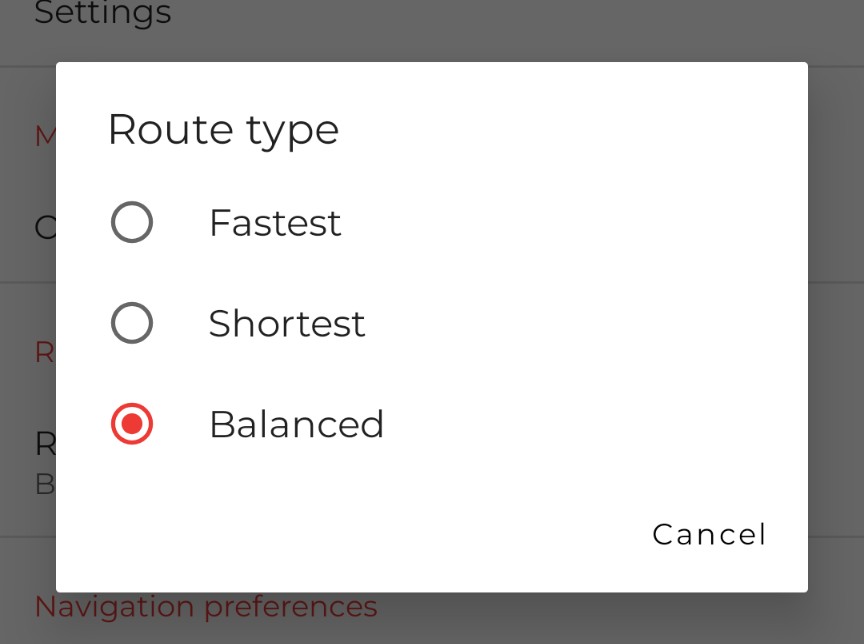
Settings include basic route styles, ferries and a setting that disables the inclusion of dirt roads as part of the route. That could be a problem in some countries where dirt roads are the only option.
I haven’t tested the following:
- Maximum route limit
- Following imported GPX routes
- Live re-routing
- Downloading routes
Lights / Night Riding. Coming soon.
Moto Guzzi V855TT Travel (2022) Specifications
| Engine Type | Transverse 90∘ V-twin, 4-stroke, OHV, 2 valves per cylinder. |
| Engine CC | 853 |
| Engine Bore x Stroke | 84 mm×77 mm |
| Engine Cooling | Air-cooled |
| Maximum Power | 76 PS (56 kW) @ 7,500 rpm |
| Maximum Torque | 82 Nm @ 5,000 rpm |
| Emissions Class | Euro 5 (119 g/km CO2) |
| Fuel Consumption | 4.9 L/100 km (official) |
| Gearbox | 6-speed |
| Clutch | Dry single disc |
| Final Drive | Shaft drive |
| Frame | High-strength tubular steel trellis frame. Engine as stressed component. |
| Seat Height | 830mm fixed. (Lower seat option: 810mm.) |
| Front Suspension | 41 mm upside-down hydraulic fork. Adjustable spring preload and rebound (170 mm travel) |
| Rear Suspension | Box-type aluminum swingarm with lateral monoshock; adjustable spring preload and rebound (170 mm travel) |
| Front Brakes | Dual 320 mm stainless steel floating discs, Brembo radial-mounted 4-piston calipers |
| Rear Brake | Single 260 mm stainless steel disc, floating 2-piston caliper |
| ABS | Continental multi-map cornering ABS (Rear ABS can be disabled in off-road mode) |
| Wheels | Cross-spoked tubeless rims |
| Tires | Front: 110/80 – R19 Rear: 150/70 – R17 |
| Seat Height | 830 mm |
| Ground Clearance | 210 mm |
| Dry Weight | 209 kg |
| Kerb Weight (Wet) | 230 kg (all fluids, 90% fuel, without standard Travel accessories) / approx. 243 kg fully equipped |
| Fuel Capacity | 23 Liters |
| Factory Equipment | Higher touring windscreen, 39L/27L plastic-and-aluminum side panniers, heated grips, Moto Guzzi MIA Bluetooth connectivity platform, center stand. |